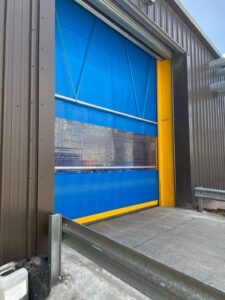
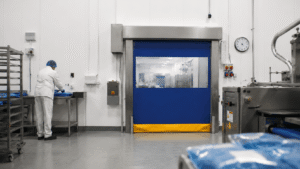
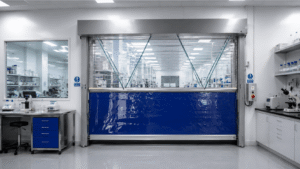
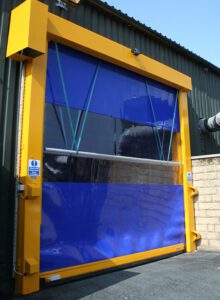
High speed doors can be integrated with conveyor systems where products or materials need to move automatically between different areas of a facility.
BID Group already has high speed doors fitted to conveyor systems in automotive manufacturing, food manufacturing, animal food manufacturing and building-product manufacturing plants. In these applications, the door forms part of the wider automated setup rather than operating completely independently.
The key is making sure the high speed door and conveyor controls can communicate so that movement through the opening is coordinated safely and efficiently.
How Do High Speed Doors for Conveyor Systems Work?
High speed doors for conveyor systems are integrated with the conveyor controls so that the two systems can share information about what is happening at the opening.
BID Group is often asked to provide signals from the door indicating whether it is:
- In motion
- Fully open
- Closed
These status signals allow the conveyor system to respond to the position of the door and coordinate movement through the opening.
The exact control logic will vary from one installation to another, but the principle is the same: the conveyor and door exchange status or control signals so they operate as part of the same process rather than as two separate systems.
Why Does the Conveyor Need to Know the Door Position?
In an automated conveyor setup, the conveyor may need confirmation that the high speed door has reached the required position before goods are allowed to pass through the opening.
Likewise, the door may need information from the wider control system before it begins to open or close.
This means the door’s status can form part of the wider conveyor logic, helping the two systems coordinate rather than operate independently.
What Needs to Be Considered When Integrating a High Speed Door With a Conveyor?
The Conveyor and Load Dimensions
The opening needs to accommodate both the conveyor itself and the goods travelling through it.
This means considering:
- Conveyor width and height
- Maximum product, pallet or load dimensions
- Any overhang beyond the conveyor
- Nearby guarding, sensors or conveyor components
- Available space around the opening
The door needs to be specified around the complete moving load, not just the dimensions of the conveyor.
How Goods Move Through the Opening
The type and pattern of product flow can also affect how the door needs to operate.
A conveyor carrying individual products or cartons may have very different requirements from one moving pallets or larger loads. The system may also operate continuously or move goods through the opening at intervals.
Controls and Communication
The high speed door and conveyor need a way to exchange the information required for the system to operate correctly.
Depending on the installation, BID Group can provide status signals showing whether the door is:
- In motion
- Fully open
- Closed
These signals can then be used by the wider conveyor control system when coordinating movement through the opening.
Sensors and Detection
Sensors may also form part of the setup to detect products or loads approaching or occupying the doorway.
The exact detection arrangement will depend on the conveyor system, the products being moved and how the door has been configured.
Space Around the Conveyor
Because the conveyor permanently occupies part of the opening, the available space around it needs careful consideration.
The high speed door guides, curtain and other components must be positioned so they can operate without conflicting with the conveyor, guarding, sensors or other equipment around the opening.
Which High Speed Door Is Suitable for a Conveyor System?
There isn’t one type of high speed door specifically designed for every conveyor application. The right solution will depend on where the conveyor is located, the size of the opening and the conditions on either side.
For example:
- Food manufacturing: a stainless steel high speed door may be appropriate where hygiene and easy cleaning are important.
- General manufacturing: the specification may be driven by the opening size, traffic and surrounding operating conditions.
- Temperature-controlled areas: a more specialist door such as the K2 Freezer High Speed Door may be required where the conveyor passes between different temperature zones.
- Larger openings: the dimensions of the conveyor and load may require a larger high speed door configuration.
High Speed Doors for Food Manufacturing Conveyor Systems
BID Group already has high speed doors integrated with conveyor systems in both food manufacturing and animal food manufacturing facilities.
In these environments, the opening may need to account for hygiene, cleaning requirements and separation between different production areas, as well as the movement of products through the conveyor system.
Where hygiene is particularly important, a stainless steel high speed door may be considered as part of the specification.
High Speed Doors for Automotive and Manufacturing Conveyors
BID Group also has conveyor-integrated high speed doors installed within automotive manufacturing and building-product manufacturing plants.
In these environments, conveyors may move components or finished products between different stages of production or separate operational zones. The high speed door can be integrated into that automated process, with its status communicated back to the wider conveyor control system.
Does an Existing Conveyor System Need to Be Modified?
Not necessarily. Whether changes are required will depend on the existing conveyor setup and how the new high speed door needs to interact with it.
This may involve assessing:
- Available control signals
- Conveyor dimensions and position
- Existing sensors and guarding
- Available space around the opening
- What information the conveyor needs to receive from the door
Some systems may be able to accommodate the high speed door within the existing arrangement, while others may require changes to the controls or surrounding layout.
What About Safety?
A high speed door integrated with a conveyor needs to be considered as part of the complete automated arrangement.
The safety requirements will depend on how the conveyor, door, products and people interact around the opening, including the positioning of sensors and other safety devices.
For a wider look at powered-door safety and compliance, read our guide to High Speed Door Safety Standards: BS EN 13241, UKCA Marking and Compliance.
Planning a High Speed Door and Conveyor Integration
If you’re planning to integrate a high speed door into a new or existing conveyor system, BID Group can assess the opening, operating environment and control requirements before recommending a suitable solution.
Our team can also consider how the door needs to communicate with the wider conveyor system so that both operate as part of the same process.
Talk to BID Group about your conveyor system requirements.
High Speed Doors for Conveyor Systems FAQs
Can high speed doors be integrated with conveyor systems?
Yes. BID Group already has high speed doors integrated with conveyor systems in automotive manufacturing, food manufacturing, animal food manufacturing and building-product manufacturing facilities.
How does a high speed door communicate with a conveyor?
The door and conveyor can exchange control or status signals so that movement through the opening is coordinated. The exact setup will depend on the individual conveyor system and how the door needs to operate within it.
Can a high speed door send open and closed signals to a conveyor system?
Yes. BID Group can provide signals indicating whether the door is in motion, fully open or closed, allowing the wider conveyor control system to respond to the door’s status.
Can a high speed door be added to an existing conveyor system?
Potentially, yes. The existing conveyor, controls, sensors, available space and opening will need to be assessed to establish how the high speed door can be integrated and whether any changes are required.
What type of high speed door is suitable for a conveyor opening?
The right door will depend on the opening size and operating environment. Different applications may require a Standard, Stainless Steel, Oversize or more specialist high speed door solution.
Are high speed doors suitable for food-production conveyor systems?
Yes. BID Group already has conveyor-integrated high speed doors installed in food and animal food manufacturing facilities. The final specification should take account of factors such as hygiene, cleaning requirements and the surrounding production environment.
What needs to be checked before adding a high speed door to a conveyor?
Key considerations include the conveyor and load dimensions, available space, existing sensors and guarding, control requirements, operating environment and how the door needs to communicate with the wider conveyor system.