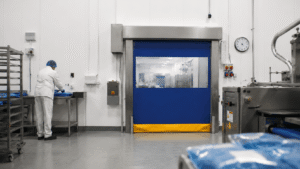
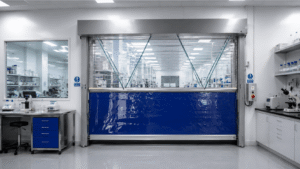
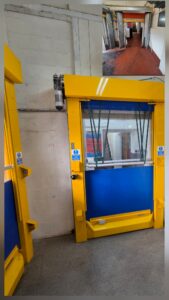
In some industrial environments, simply installing two doors between adjoining areas is not enough. The doors may need to communicate with each other so that the position of one determines whether the other is allowed to open.
An interlocked door system controls this sequence, typically preventing both doors from being open at the same time. One door must close before the second is permitted to open, helping maintain separation between the two areas.
High speed doors are well suited to these applications where the controlled sequence also needs to accommodate frequent movement of pedestrians, forklifts, vehicles or goods.
What Is a Door Interlock?
A door interlock links the control systems of two or more doors so that the status of one door determines whether another is permitted to operate.
In a basic two-door arrangement:
- Door A can open while Door B remains closed.
- Door A must close before Door B is permitted to open.
- The same sequence can operate in the opposite direction for return traffic.
The interlock itself is the control logic between the doors, rather than a particular type of door. Its purpose is to coordinate how the openings operate so that both are not normally open at the same time.
How Does a Two-Door Interlock Sequence Work?
A typical two-door interlock sequence works as follows:
- A person, forklift or vehicle requests access at Door A.
- The control system checks that Door B is closed.
- Door A is permitted to open.
- The person, vehicle or goods move into the intermediate area.
- Door A closes.
- The controller confirms that Door A has reached the required closed position.
- Door B is then permitted to open.
- Once traffic has passed through, Door B closes and the system returns to its normal state.
The exact sequence can be configured differently depending on the application. For example, some systems can register a request for Door B while Door A is still open, then automatically allow the next stage of the sequence once Door A has closed.
The important principle is that each door responds to the status of the other, creating a controlled sequence rather than allowing both openings to operate independently.
What’s the Difference Between Two Interlocked Doors and an Airlock?
Two interlocked doors describe how the doors are controlled. An airlock describes the controlled space between adjoining areas, with interlocking used to manage movement through it.
Simply installing two doors does not automatically create a functional airlock. Depending on the application, the intermediate space may also be designed to help maintain:
- Air pressure differences
- Cleanliness or hygiene separation
- Controlled atmospheres
- Restricted access
- Separation between process areas
In pharmaceutical and cleanroom environments, for example, airlocks can be used to help maintain pressure control and separation between adjoining spaces. The exact purpose and design of an airlock will depend on the environment it serves.
What Controls an Interlocked Door System?
For an interlock to operate correctly, the control system needs to know the status of each door before allowing the next stage of the sequence.
Depending on the installation, this can involve:
- Door-open and door-closed status signals
- Presence detectors
- Photocells or light curtains
- Vehicle detection
- Push buttons or pull cords
- Traffic lights or warning indicators
- Control inputs and outputs between doors
- Access-control signals
These inputs allow the controller to determine whether a door can open, whether it should remain closed or whether an opening request should be held until the required conditions are met.
What Happens If Someone Is Still in the Opening?
The interlock sequence should not override the safety systems protecting the doorway.
If a person, vehicle or object is detected within the opening, appropriate safety devices such as presence sensors, photocells or light curtains can prevent or interrupt unsafe closing, depending on how the system has been designed.
The sequencing logic and safety systems therefore work together, but perform different roles: the interlock controls which door is permitted to operate, while the safety devices help protect people and equipment during that operation.
How Does Timed Opening and Closing Logic Work?
Interlocking does not necessarily mean the second door opens immediately as soon as the first door closes. The sequence can include programmed timings and conditions suited to the way the opening is used.
Depending on the application, this may include:
- Automatic closing after a set period
- A delay before the second door can open
- Holding an opening request until the first door has closed
- Automatic opening once the required conditions are satisfied
- Resetting the sequence once both doors are closed
There is no universal timing that will suit every system. The sequence should be configured around factors such as pedestrian or vehicle movement, the size of the controlled area and the purpose of maintaining separation between the two spaces.
Can an Interlocked Door System Work With Access Control?
Yes. Interlocked high speed doors can be integrated with access-control and activation systems such as:
- Card or fob readers
- Keypads
- Remote controls
- Building access-control systems
- Vehicle activation systems
The two systems perform different functions. Access control determines whether a person or vehicle is authorised to pass through, while the interlock determines when the relevant door is permitted to open.
For example, an authorised user may request access at Door A, but the controller will still prevent that door from opening if the interlock conditions have not been met.
What Happens in an Emergency or System Fault?
The way an interlocked door system responds to an emergency, power loss or system fault will depend on the installation and its risk assessment. There is no single emergency sequence that will be appropriate for every application.
Depending on the system, provision may include:
- Emergency stop or release functions
- A safe operating mode
- Manual release arrangements
- Fault or status indication
- An authorised override of the normal interlock sequence
- Backup power where required by the installation
The important principle is that the normal interlocking sequence must not prevent the system from responding safely when something goes wrong. HSE guidance states that users of powered doors should know how to switch equipment off or place it into a safe condition and, where necessary, how to release someone who has become trapped.
Emergency and fault behaviour should therefore be considered as part of the overall system design rather than assuming, for example, that both doors should automatically open or remain locked in every situation.
Typical High Speed Door Interlock Configurations
Interlocked high speed doors can be configured in different ways depending on how people, vehicles or materials need to move between areas.
Two-Door Personnel or Material Airlock
Two high speed doors are positioned either side of a controlled intermediate space. One door is normally required to close before the other is permitted to open.
Forklift or Vehicle Transfer Zone
Vehicle detection or another activation device requests access through the first door. The second remains unavailable until the required stage of the first door’s sequence has been completed.
Clean or Controlled Production Area
Interlocked doors can help maintain separation between controlled areas where factors such as cleanliness, pressure or contamination need to be managed. For example, UK forensic guidance recommends interlocking lobby doors in DNA clean laboratories to help minimise contaminant ingress.
Secure Access Zone
Access control can be combined with the interlock so that authorised people or vehicles can proceed through the system while the two controlled openings remain coordinated.
Where Are Interlocked High Speed Doors Useful?
Interlocked high speed doors can be useful wherever maintaining separation between two areas is important while people, vehicles or goods still need to move between them.
Typical applications include:
- Pharmaceutical and cleanroom facilities
- Food and beverage production
- Temperature-controlled environments
- Manufacturing and process facilities
- Warehouses and logistics operations
- Secure or restricted-access areas
The reason for using an interlock will vary between facilities. In one environment the priority may be contamination control, while in another it could be controlled access or maintaining separation between operational areas.
Specifying an Interlocked High Speed Door System
The right interlock arrangement depends on more than simply selecting two doors. The complete system should take account of:
- What moves through the opening
- Frequency and direction of traffic
- Required separation between areas
- Activation methods
- Access-control requirements
- Safety requirements
- Required behaviour during faults or emergencies
HSE emphasises that the safety of powered-door systems depends on how components such as sensors, safety devices and controllers are combined for the particular operating environment.
BID Group can assess your opening, traffic requirements and control needs to help specify, install and maintain an appropriate interlocked high speed door or airlock system.
Talk to our team to discuss your requirements.
Interlocked High Speed Door FAQs
What is an interlock on a high speed door?
A door interlock connects the control logic of two or more doors so that the status of one affects whether another is permitted to operate. In a typical two-door system, one door must close before the second can open.
Can two high speed doors be interlocked?
Yes. Two high speed doors can be configured so their controllers communicate and operate in a defined sequence rather than independently.
Can both doors in an airlock open at the same time?
In a typical interlocked arrangement, the system is configured to prevent both controlled doors from being open simultaneously during normal operation. However, the precise operating and emergency logic should be determined by the requirements and risk assessment of the individual installation.
What is the difference between an airlock and two interlocked doors?
Interlocking describes the control relationship between the doors. An airlock describes the controlled intermediate space and overall system between adjoining areas. Interlocking is commonly used as part of an airlock, but simply installing two doors does not by itself define the purpose or performance of the intermediate space.
Can interlocked high speed doors connect to an access-control system?
Yes. Depending on the installation, interlocked doors can work with systems such as card or fob readers, keypads and other authorised activation methods. Access control determines whether access is authorised, while the interlock controls when the relevant door is permitted to operate.
What happens to an interlocked door system during a power failure or emergency?
This depends on the design of the installation. The system may incorporate manual release, emergency controls, safe operating modes, authorised overrides or backup power.
Emergency behaviour should be determined according to the risks and requirements of the individual site rather than relying on one universal sequence.
Where are high speed door airlocks commonly used?
They are commonly suited to environments where movement needs to take place without leaving two adjoining areas directly open to each other, including clean and controlled production facilities, food manufacturing, temperature-controlled environments, logistics operations and restricted-access areas.