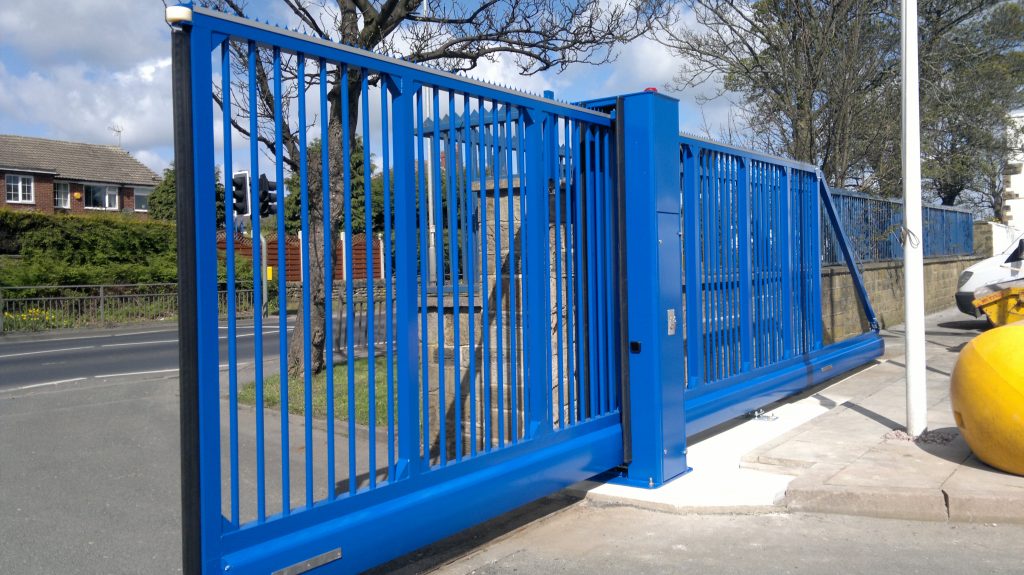
Sliding security gates have become a popular choice for businesses looking to strengthen perimeter control without compromising on space or efficiency.
Designed to offer robust protection and streamlined access, these gates are a smart solution for securing industrial and commercial premises of all sizes.
Their appeal lies in their reliability and practicality: sliding gates operate smoothly, take up minimal space, and integrate easily with access control systems. Whether you’re safeguarding a distribution hub, warehouse, or car park, they offer the security and performance required for high-traffic environments.
In this guide, we’ll walk you through how sliding security gates work, the different types available, and what to consider before installation, so you can make an informed choice that fits your facility’s needs.
What Are Sliding Security Gates?
Sliding gates open horizontally rather than swinging outwards, making them ideal for sites where space is limited or where vehicle access is frequent.
The gate typically slides along a track fixed to the ground or, in the case of cantilever designs, is supported by rollers without the need for a ground rail.
Tracked sliding gates run along a fixed guide rail and are best suited to level ground. They’re incredibly stable and often used in wide entrances or busy commercial access points.
Cantilever sliding gates, on the other hand, are free of ground tracks and instead glide along rollers mounted on a support post. This design works well in locations where debris, snow, or uneven surfaces might obstruct a traditional track.
Both types deliver reliable, controlled access while maintaining high standards of security.
Where Sliding Gates Are Commonly Used
We install sliding security gates across a wide range of commercial and industrial settings. They’re commonly used in:
- Logistics yards and depots
- Industrial estates and manufacturing plants
- Car parks and commercial entrances
- Emergency service and transport facilities
- High-security zones requiring controlled vehicle access
Wherever you need secure, efficient access without sacrificing space or reliability, a sliding gate provides a practical solution that can be fully tailored to your requirements.
Key Benefits of Sliding Security Gates
Space Efficiency
Sliding gates are the ideal choice for premises where space is limited. Because they open sideways along a track or rail, they eliminate the need for the wide arc that traditional swing gates require.
This makes them particularly useful for locations with limited frontage or sloped driveways, where standard gate configurations may not be practical.
If you’re working with tight boundaries or maximising usable yard space, sliding gates will allow you to secure your site without compromising on layout or functionality.
Enhanced Perimeter Security
As a physical barrier, sliding gates offer dependable protection for both vehicles and pedestrians. Their robust construction makes them difficult to force or bypass, and when paired with access control systems like ANPR cameras, keypads, or RFID readers, they provide a high level of control over who enters and exits your premises.
Sliding security gates are often used in high-risk or high-traffic environments where reliable access management is essential, from commercial depots to critical infrastructure facilities.
Smooth Automation & Integration
When fitted with electric motors, sliding gates provide seamless, quiet operation that fits into the flow of a busy site. They can be programmed to respond to a variety of triggers including scheduled timers and vehicle sensors to fobs and remote access systems. This allows for smooth, responsive entry and exit.
We can also integrate sliding gates with CCTV, intercom systems, and remote monitoring tools to provide a complete, connected security solution.
Durable and Low Maintenance
Our sliding gates are engineered for long-term reliability. With high-strength materials and protective finishes, such as galvanised steel or powder coating, they resist corrosion, weather damage, and heavy use.
Because they rely on fewer moving parts than swing gates (especially cantilever models), sliding gates typically experience less wear and tear in high-traffic environments, making them a practical choice for busy sites that demand consistent performance.
Types of Sliding Security Gates
Cantilever Sliding Gates
Cantilever gates operate without a ground track, using a system of rollers and counterbalance to support the gate as it slides. This design is ideal for areas where the ground surface is uneven, obstructed, or frequently impacted by dirt, snow, or debris.
They’re also favoured for high-traffic entrances, as they require less day-to-day maintenance and can continue to operate smoothly even in challenging conditions.
Tracked Sliding Gates
Tracked sliding gates offer smooth and stable operation across level ground. They run along a fixed ground track, which helps maintain alignment, even on particularly wide openings, making them a popular choice for large commercial and industrial entrances.
They require a clean, well-maintained track for optimal performance but offer unmatched stability where site conditions allow.
Manual vs. Automatic Sliding Gates
Manual sliding gates offer a cost-effective solution for low-traffic areas where electric automation isn’t required. They’re simple to operate and maintain, making them suitable for storage yards, depots, and smaller commercial premises.
Automatic sliding gates, on the other hand, are ideal for high-security or high-traffic environments. They streamline access, reduce manual handling, and support modern access control technologies, all while enhancing safety, efficiency, and site management.
What to Consider Before Installation
Site Assessment and Planning
Before installing a sliding gate, it’s essential to assess your site properly. Factors like ground level, available space, entrance width, and how frequently the gate will be used all impact the type of gate system required.
A sloped driveway, for instance, may require a cantilever design rather than a tracked one.
We always recommend a professional survey to evaluate your site’s needs and any challenges that could affect installation. This ensures we specify a solution that delivers long-term performance and integrates smoothly with your day-to-day operations.
Compliance & Safety Regulations
If your sliding gate is automated, compliance with UK safety regulations is non-negotiable. Standards like BS EN 12453 govern how powered gates should operate safely, including rules around obstacle detection, emergency stops, and force limitation.
At BID Group, we build safety into every stage, from design and installation to testing and maintenance. We ensure your system includes essential safety features like photocells, pressure edges, and signage to keep your team, visitors, and vehicles protected.
Integration with Wider Security Strategy
Sliding security gates are most effective when they form part of a larger perimeter protection strategy. We work closely with clients to integrate gates with existing or planned infrastructure, including fencing, bollards, access control systems, and surveillance.
Whether you need ANPR vehicle tracking, keypad entry, or remote monitoring, we can provide a cohesive setup that strengthens site security while improving operational flow.
Why Choose BID Group for Sliding Gate Installation
At BID Group, we know that every site is different, which is why we tailor every sliding gate to suit your exact needs. Whether you’re managing a high-traffic distribution hub, a secure car park, or a retail compound, we design and install gates that align with your layout, usage, and security expectations.
Our gates are built to last and installed by experienced engineers who understand the demands of commercial and industrial environments.
Ongoing Maintenance & Support
A high-performing gate is only as good as its ongoing maintenance. That’s why we offer planned servicing and responsive support, helping to minimise downtime and extend the life of your gate.
With regular compliance checks and performance inspections, we keep your gate safe, efficient, and up to date with the latest standards.
Sliding Security Gates FAQs
What is the difference between cantilever and tracked sliding gates?
Tracked sliding gates run along a ground track and are guided by rollers, making them ideal for level surfaces. Cantilever gates, on the other hand, are supported from one end and slide without touching the ground. This is perfect for uneven, sloped, or debris-prone areas where a ground track would be impractical.
Are sliding gates better than swing gates?
The decision between sliding gates vs swing gates depends on your site. Sliding gates are usually more space-efficient because they move horizontally rather than needing a wide swing arc. They’re also better suited to high-traffic or heavy-duty environments where security and reliability are critical. However, swing gates may be more appropriate for sites with limited side space.
Can sliding security gates be automated?
Yes. We regularly install automated sliding gates with integrated motors, remote controls, and full access control systems such as ANPR cameras, keypads, or fob entry. Automation boosts security and convenience, especially for commercial and industrial sites.
How much maintenance do sliding gates require?
Sliding gates, particularly cantilever models, require minimal maintenance when installed correctly. We recommend periodic checks for wear on moving parts, motor performance, and safety systems like photocells and emergency stops to ensure continued compliance and reliability.